

Most ecommerce brands running Meta and Google ads are leaving 60–70% of their ROAS on the table. Here's the integrated system that closes the gap — and what 5–10x ROAS actually requires.
How Ecommerce Brands Are Hitting 5–10x ROAS Within 90 Days (Without Increasing Ad Spend)
The average Meta ads ROAS for ecommerce brands in 2025 sits at 2.19:1 (WebFX, 2025). Most brands accept this as a ceiling. The brands hitting 5x, 8x, 10x ROAS aren't running better creative. They're running a different system.
The difference isn't budget. It isn't a secret audience or a proprietary bidding strategy. It's what happens to the traffic after the ad is clicked — and what happens to the data those clicks generate. An ecommerce brand running siloed paid ads will consistently land between 2x and 3x ROAS and wonder why scaling ad spend doesn't improve it. A brand running an integrated system — connecting ads, landing pages, email, retargeting, and attribution into one coherent machine — compounds toward 5x–10x within a quarter.
This post breaks down what that system actually looks like, where most brands are losing ROAS without knowing it, and what a 90-day build looks like from the ground up.
Read more: The Real Cost of Siloed Marketing (And How to Fix It)
Key Takeaways
- Average Meta ROAS for ecommerce is 2.19:1 — retargeting campaigns average 3.61:1, cart abandoners 6–12:1 (WebFX, 2025)
- 70.19% of shoppers abandon their cart — brands with a 3-email recovery sequence recapture 37% more than those with one (Analyzify, 2025)
- Only 9% of marketers have fully adopted cross-channel marketing — those who do see 13% higher ROAS (Amra & Elma, 2025)
- Omnichannel integrated campaigns produce 179% faster revenue growth than siloed approaches (Marketing LTB, 2025)
- The gap between 2x and 8x ROAS is almost never the ad — it's the system the ad feeds into
Why Most Ecommerce Brands Are Stuck at 2–3x ROAS
The median ecommerce brand on Meta is generating around 2.19:1 ROAS. Google Shopping campaigns average 3–4x (Triple Whale, 2025). These numbers feel like benchmarks. They're actually baselines — the floor of what's achievable without a system, not the ceiling.
There are three specific reasons most ecommerce brands plateau here.
First: They're optimizing the ad instead of the system. A brand hitting 2.5x ROAS will typically respond by A/B testing new creative, adjusting copy, trying different audiences. All of these are reasonable moves. But if the landing page has a 3-second load time, if the post-purchase email sequence doesn't exist, if there's no retargeting cohort capturing cart abandoners — the best ad in the world hits a conversion ceiling that creative can't move.
Second: They're treating each channel as a standalone investment. Paid ads are bought from one agency. Email is managed by a different tool, or nobody. The website was built by a designer without a conversion brief. Each channel has someone optimizing it in isolation. The handoffs between channels — ad to landing page, landing page to email capture, email to retargeting — are nobody's responsibility.
Third: They can't see what's working. Without UTM tagging, without connected attribution, without a single dashboard showing which campaign generated which purchase, decisions are made on partial data. You see clicks. You see some revenue. You can't confidently say which ad drove which sale, so you can't double the budget on what's working or cut what isn't.
Our observation: When we audit an ecommerce brand's marketing stack, the pattern is almost always the same. There are 4–6 marketing tools in play — ad platform, email tool, analytics, CRM or Shopify — and almost none of them are sharing data. The email list isn't synced to Meta custom audiences. The ad UTMs aren't being captured at checkout. Retargeting campaigns are targeting all site visitors, not segmented by intent. Every one of these gaps is a ROAS leak. We've never worked with a brand where fixing the system didn't move ROAS faster than improving the ad.
Where ROAS Hides: The Five Leaks in a Typical Ecommerce Stack
Leak 1: No UTM attribution. Without properly tagged URLs on every ad, you can't tell which campaign drove which purchase. You see revenue in Shopify; you see clicks in Meta. You can't connect them. Every optimization decision — what to scale, what to cut — is a guess. Fixing this is a one-hour task that makes every future decision smarter.
Leak 2: Ad-to-page message mismatch. Your ad makes a specific promise — "50% off running shoes this weekend only." The landing page it sends traffic to is your homepage. The visitor arrived expecting one thing, found another, and left. Message match is the single highest-leverage conversion variable. A dedicated landing page that mirrors the ad's offer and language typically doubles the conversion rate of the same ad sending traffic to a homepage.
Leak 3: Cart abandonment with no recovery. 70.19% of shoppers who add items to a cart don't complete the purchase (Analyzify, 2025). Most ecommerce brands have no recovery sequence. A three-email cart abandonment sequence recovers 37% more carts than a single email (Codexpert, 2025), and the ROAS on those recovery emails runs 6–12x because you're reaching someone who already showed purchase intent.
Leak 4: Email list not synced to ad audiences. Your email subscribers are warm buyers. They've already engaged, possibly purchased. Meta can use your email list to create a custom audience for retargeting and a lookalike audience for prospecting. If your email list lives in Klaviyo or Mailchimp and never syncs to Meta, you're paying cold CPMs to reach people you already know, or missing the highest-performing audience segment for your campaigns entirely.
Leak 5: No post-purchase LTV sequence. The cheapest customer to acquire is the one you already have. A customer who buys once and receives no follow-up sequence, no cross-sell, no loyalty touchpoint will not buy again unless they happen to see your ad in their feed. A three-email post-purchase sequence — delivered across 30 days — converts 15–25% of first-time buyers into repeat customers. Repeat buyers have zero acquisition cost. Their purchases are pure ROAS.
The 90-Day System: How Integrated Ecommerce Brands Actually Scale ROAS
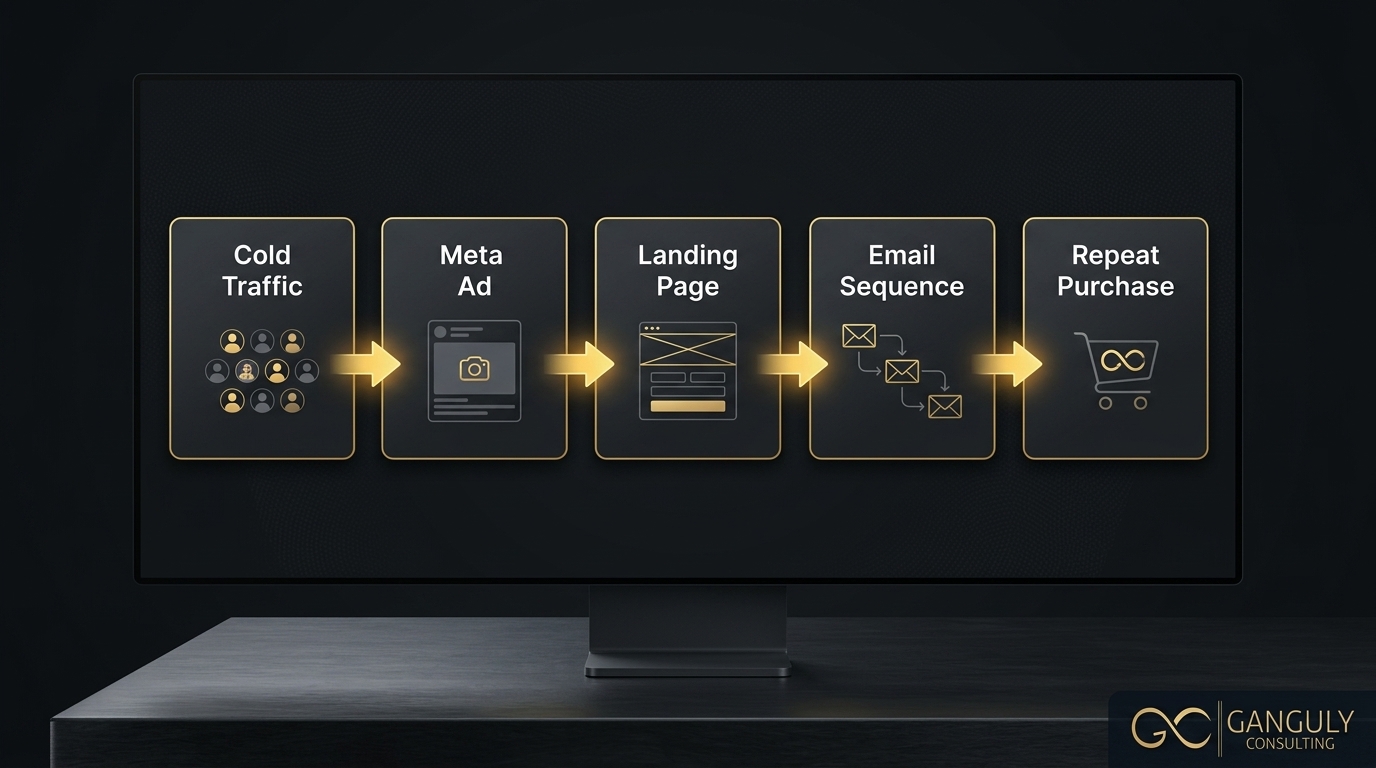
The 5x–10x ROAS outcome doesn't happen from one campaign. It compounds over 90 days as each component of the system activates and starts feeding the others. Here's how it maps month by month.
Month 1: Build the Foundation
The first 30 days are infrastructure, not performance. This is what makes month three possible.
Fix UTM tagging across every active campaign. Connect your email platform to Meta custom audiences. Build one dedicated landing page for your primary campaign — not your homepage, not your category page, a page built specifically to receive that ad's traffic and convert it. Set up the three-email cart abandonment sequence. Set up the two-email post-purchase sequence.
At the end of month one, you have clean attribution, a conversion-optimised page, and automated recovery and retention sequences. Performance may look similar to where you started. That's normal — the data is just beginning to accumulate.
Month 2: Test and Segment
With clean attribution in place, you can now see which campaigns are generating buyers versus browsers, which audience segments have the best lead-to-purchase rate, and which ad creatives are driving the highest-value orders.
Build a retargeting campaign specifically for cart abandoners who didn't convert via email. Retargeting campaigns to cart abandoners produce 6–12x ROAS versus the 2–3x of cold traffic (Billo, 2025). This is the highest-ROAS lever in ecommerce, and most brands either don't run it or run it against all site visitors instead of segmented by intent.
Build a lookalike audience from your top 10% buyers — the customers with the highest LTV. Run a cold prospecting campaign targeting that audience. This is typically 40–60% more efficient than demographic or interest-based targeting because you're matching people to your actual best customers.
Month 3: Scale What's Proven
By day 60–70, you have two to three months of clean data. You know your cost per acquisition by campaign, your cart recovery rate, your email-to-purchase rate, and your repeat purchase rate.
Scale spend into the campaigns and audiences that have proven LTV efficiency. Cut the campaigns that are generating clicks but not buyers. Expand the cart abandonment and post-purchase sequences — add a fourth email, test a discount trigger at email three, add SMS as a recovery channel for high-value carts.
Brands that run this 90-day sequence consistently report ROAS moving from the 2–3x baseline into the 5–8x range by the end of the third month. Brands that go further — integrating loyalty programs, user-generated content in retargeting, and predictive segmentation — reach 10x+ sustained ROAS. All from the same ad budget they started with.
The Numbers That Make This Concrete
If you're running $10,000 per month in ad spend and achieving 2.5x ROAS, you're generating $25,000 in revenue.
Close Leak 2 (landing page message match): conversion rate doubles on your primary campaign. Same traffic, same spend, more buyers. ROAS moves to 3.5–4x. Revenue: $35,000–$40,000.
Add Leak 3 fix (cart abandonment recovery): 10–15% of abandoners convert via email. These have zero additional ad spend. ROAS effectively increases because total revenue goes up without touching the ad budget. ROAS moves to 4.5–5x. Revenue: $45,000–$50,000.
Add Leak 5 fix (post-purchase sequence): 20% of buyers make a second purchase within 60 days. These are also zero ad spend. ROAS continues to climb. Revenue from the same $10,000 ad budget: $55,000–$65,000. Effective ROAS: 5.5–6.5x.
Layer in retargeting to cart abandoners and lookalike audiences from your best buyers (Leaks 4 and 1 closed), and the efficient spend compounds further. The $10,000 budget is now generating $70,000–$100,000 because you've closed the leaks and every dollar is working harder than before.
This isn't theoretical. It's the output of the system — and the reason integrated brands consistently outperform siloed ones by 2–4x on the same budget.
Only 9% of marketers have fully adopted cross-channel marketing strategies (Amra & Elma, 2025). Those who do earn 13% higher ROAS. That gap is not from running better ads. It's from operating a system while everyone else is running channels.
Read more: Meta Ads + Landing Page + CRM: The Lead Gen Stack That Actually Works
What We Actually Build for Ecommerce Clients
When Ganguly Consulting works with an ecommerce brand, the first 90 days follow a fixed sequence:
Days 1–14: Audit every active ad and its destination URL. Tag every campaign with UTMs. Connect the email platform to Meta custom audiences. Identify the primary product or category with the highest margin and best conversion potential.
Days 15–30: Build a dedicated landing page for the primary campaign. Set up cart abandonment sequence (3 emails, 1hr / 24hr / 72hr triggers). Set up post-purchase sequence (Day 1 / Day 7 / Day 30). Activate retargeting for cart abandoners and recent site visitors.
Days 31–60: Launch lookalike audiences from top buyers. Test 2–3 landing page variants. Review attribution weekly — what's generating buyers, not just clicks. Optimize based on actual purchase data, not CTR.
Days 61–90: Scale proven audiences and creatives. Cut underperformers. Expand sequences where open rates and conversion rates justify it. Build the monthly reporting dashboard that shows ROAS by campaign, email revenue, and repeat purchase rate in one view.
The output by day 90: a brand that knows exactly where its revenue comes from, has automated recovery and retention running 24/7, and is spending ad budget only on what demonstrably acquires profitable customers.
Frequently Asked Questions
What's a realistic ROAS target for an ecommerce brand in the first 90 days?
It depends on your starting point and your margins. Brands starting from 2–2.5x ROAS typically reach 4–5x by day 90 from closing the landing page, cart recovery, and attribution leaks. Brands that also activate retargeting to cart abandoners and post-purchase sequences consistently reach 6–8x. The 10x+ range requires both a strong integrated system and a product with enough margin to absorb the investment in the build — typically achievable by month four to six for brands with AOV over $80.
Do we need to increase our ad budget to improve ROAS?
No — that's the key point. ROAS improvement from system integration comes from making your existing budget more efficient, not from spending more. Closing the five leaks described in this post typically improves ROAS by 2–4x without touching spend. Once ROAS is healthy and attribution is clean, scaling budget is low-risk. Before that, scaling budget into a leaky system just accelerates the waste.
How important is the landing page versus the ad creative for ROAS?
Both matter, but the landing page is typically the higher-leverage intervention for brands stuck below 3x ROAS. The ad gets the click; the landing page converts it. Most brands iterate obsessively on ad creative while sending all traffic to a homepage or generic category page. A landing page that mirrors the ad's message and has one clear action consistently outperforms a generic page regardless of how strong the ad is. Fix the page before testing more creative.
Is email still effective for ecommerce in 2025?
Automated emails (triggered by behavior — cart abandonment, post-purchase, win-back) generate an average of $2.87 per email compared to $0.18 for broadcast campaigns (Mailchimp, 2025). The difference is specificity — behavioral emails reach the right person at exactly the right moment. For ROAS purposes, cart recovery and post-purchase sequences are the two highest-ROI automations an ecommerce brand can run. They cost nothing per send beyond the platform fee and produce revenue from an audience that has already demonstrated purchase intent.
How do we know if our current ROAS is "good"?
The Meta benchmark of 2.19:1 is the industry average — but average includes brands with no system at all. A better question is: what's your ROAS by campaign, by audience, and by product? If your cold traffic campaigns are at 2x but your retargeting is at 6x, the signal is clear — put more budget into retargeting and work on the cold traffic system. If your ROAS is consistent across all campaigns, you may not have enough segmentation to optimize. The goal is not a single ROAS number. It's knowing where the best ROAS comes from so you can concentrate spend there.
ROAS Is a System Output, Not a Campaign Variable
The brands that consistently hit 5–10x ROAS aren't doing something the others haven't thought of. They've built a system where every part of the funnel — the ad, the page, the cart, the email, the retargeting — is connected and each feeds the next.
The brands stuck at 2–3x have individual tactics. Good ads. An email list. A CRM. But the pieces aren't talking to each other, the data isn't flowing, and every campaign starts cold because nothing has been built to retain and compound.
The 90-day window is enough time to close the critical leaks, activate the recovery and retention sequences, and have enough clean data to make confident scaling decisions. It's not enough time to build a brand — but it's enough to build the system that makes brand-building possible.
That's the difference between ecommerce marketing and an ecommerce growth system.
Read more: The Complete Guide to Building a Digital Growth System for Service Businesses
Abhisek Ganguly is the founder of Ganguly Consulting, a premium tech and growth consulting firm that helps ecommerce brands and service businesses build integrated digital growth systems. Ganguly Consulting works at the intersection of technology, marketing, and business strategy.