

63% of CMOs face increased pressure from CFOs to prove marketing value. Yet most can't. The problem isn't the marketing — it's the measurement infrastructure. Here's what the 21% who can prove it are doing differently.
Why Only 21% of Marketers Can Prove ROI — And What the 79% Are Missing
There's a number that appears consistently across multiple years of marketing leadership research: somewhere between 21% and 29% of marketers can demonstrate a clear, credible return on their marketing investment. The rest — the 71% to 79% majority — operate on intuition, lagging indicators, or metrics that measure activity rather than revenue impact.
This isn't primarily a data access problem. Most businesses have more marketing data today than at any point in history. GA4 is free. Meta's ad manager produces detailed reports. Most CRMs generate pipeline dashboards. The data exists. What's missing is the infrastructure that connects it — that links a specific ad to a specific lead to a specific client to specific revenue.
63% of CMOs report increased pressure from CFOs to prove marketing value — up from 52% the year prior — and 61% face the same pressure from CEOs (CMO Survey, Spring 2025, 281 marketing leaders). For a service business founder who is both the CMO and the CEO, that pressure is entirely self-imposed — but no less real. You want to know if your $3,000 a month in Meta ads is working. You want to know if the website redesign paid off. You want to know, with data rather than gut feel, what to do more of and what to cut.
This post explains why most service businesses can't answer those questions, what the 21% who can are doing differently, and how to build the measurement infrastructure that makes your marketing provable.
Read more: Why Your Website, Ads, and CRM Need to Work as One System
Key Takeaways
- Only 41% of marketing leaders rate their organisations as mature in marketing performance measurement, despite 83% agreeing it's essential (McKinsey, 2024)
- 74% of marketing leaders have killed or scaled back a campaign they couldn't measure — not because it wasn't working, but because they couldn't prove it was (Haus, 2026)
- 64% of marketers say their attribution data doesn't reflect reality; 78% say it doesn't match revenue reports (RevSure, 2024)
- The top attribution challenge is lack of expertise (42%), followed by difficulty tracing customer touchpoints (41%) (MarketingProfs/Ascend2, 2024)
- GA4 now runs on 14.8 million websites globally — the data infrastructure exists; the connection layer is what's missing
The Measurement Gap Is Getting Worse, Not Better
Marketing measurement has a paradox at its centre. More tools, more data, and more dashboards exist than ever before — and yet the percentage of businesses that can credibly attribute marketing spend to revenue outcomes has barely moved in a decade.
McKinsey's 2024 survey of marketing leaders found that 83% agree marketing performance measurement is essential to their organisation — but only 41% describe themselves as mature in actually executing it (McKinsey, 2024). That 42-point gap between aspiration and execution is where most marketing budget is wasted.
The Haus 2026 Decision Confidence Index, surveying 500 senior marketing and finance leaders, found that 51% cannot clearly explain their marketing measurement approach to their board. 74% have killed or scaled back a marketing initiative because they lacked confidence in how to measure its impact — not because the initiative was failing, but because they couldn't prove it was succeeding (Haus, 2026).
For a service business, this has a specific and expensive consequence. When you can't measure which campaign generated which client, the default is to either cut everything (and lose channels that were working) or keep spending on everything (and keep paying for channels that aren't). The inability to measure forces binary, poor-quality decisions.
Our observation: The most common reason we find marketing budgets underperforming in service businesses isn't channel selection — it's the absence of attribution at the handoff point. The ad platform knows who clicked. The landing page knows who converted to a form. The CRM knows who became a lead. But none of these three talk to each other, so nobody knows which ad became which lead became which client. The data exists in three separate systems. The connection is missing.
Why Attribution Is Broken for Most Service Businesses
RevSure's 2024 State of Marketing Attribution found that 64% of marketers say their attribution doesn't reflect reality, and 78% report their attribution data doesn't match their revenue reports (RevSure, 2024). Nearly 90% of B2B companies use single-touch or basic multi-touch attribution models — meaning they're either crediting the first channel a prospect touched or the last one, without any understanding of the full journey in between.
The top three attribution challenges identified by MarketingProfs and Ascend2's 2024 survey of 357 marketing decision-makers: lack of expertise (42%), difficulty tracing customer touchpoints (41%), and limited resources for analysis (40%) (MarketingProfs/Ascend2, 2024).
For a service business, these challenges have a specific shape. A client typically encounters you in multiple ways before booking: they see an ad, visit the website, read a blog post, see a LinkedIn post, get referred by someone who mentioned they'd seen your content, and then finally book a call. Which of those touchpoints gets the credit? In most service business setups, the answer is whichever one is easiest to track — usually the last click, usually the form submission. The entire journey that preceded it is invisible.
This creates a systematic bias toward underinvesting in early-stage awareness content (because it never gets credit in last-click models) and overinvesting in direct-response channels (because they're easy to track even when they didn't do the persuasion work).
The Three Measurement Problems — and What Fixes Each
The measurement gap in a service business almost always comes from one or more of three specific problems:
Problem 1: Data exists in disconnected silos.
Your Meta ads manager shows impressions, clicks, and leads. Your CRM shows contacts, pipeline stages, and closed revenue. Your website analytics show sessions, bounce rate, and time on page. None of these systems talk to each other by default. So you can see that you got 23 leads from ads this month, and you can see that you closed 2 new clients, but you cannot connect those two facts — you don't know if the 2 clients came from the 23 leads or from referrals or from something else entirely.
The fix: UTM parameters + CRM source tracking. Every ad URL should include ?utm_source=facebook&utm_medium=paid&utm_campaign=[name]. When a lead fills out your landing page form, your CRM captures those parameters and stores them on the contact record. When that lead becomes a client, their source is attached to the revenue. You now have attribution.
Problem 2: The measurement model doesn't match the sales cycle.
Service businesses have longer sales cycles than the attribution window most tools use by default. Meta's default attribution window is 7 days. If your average time from first click to booked call is 14 days, and your average close cycle is 45 days, you're looking at 7-day attribution data and concluding that campaigns are failing when they're simply not yet complete.
The fix: Extend attribution windows in your ad platforms. Set Meta to 28-day click attribution. In GA4, configure custom lookback windows that match your actual sales cycle. And most importantly, use your CRM — not your ad platform — as the final source of truth for revenue attribution, because only the CRM knows when a lead became a client.
Problem 3: You're measuring activity, not outcomes.
Most service businesses measure the metrics that are easiest to access: ad impressions, website sessions, email open rates, LinkedIn likes. These are activity metrics. They tell you that something is happening. They don't tell you whether that something is generating revenue.
35% of marketing leaders admit that more than 20% of their budget is inefficiently allocated — yet many cannot identify where the waste is (Haus, 2026). The reason they can't identify it is that they're monitoring activity (we got 5,000 impressions this week) rather than outcomes (we got 3 qualified calls this week that originated from paid campaigns).
The fix: Define three outcome metrics and review them weekly:
- Leads by source — how many new CRM contacts this week, and which channel brought each one
- Conversion rate by source — what percentage of leads from each source booked a call
- Revenue by source — which channels contributed to closed revenue this month
Read more: The Real Cost of Siloed Marketing (And How to Fix It)
What a Measurement-Mature Service Business Looks Like
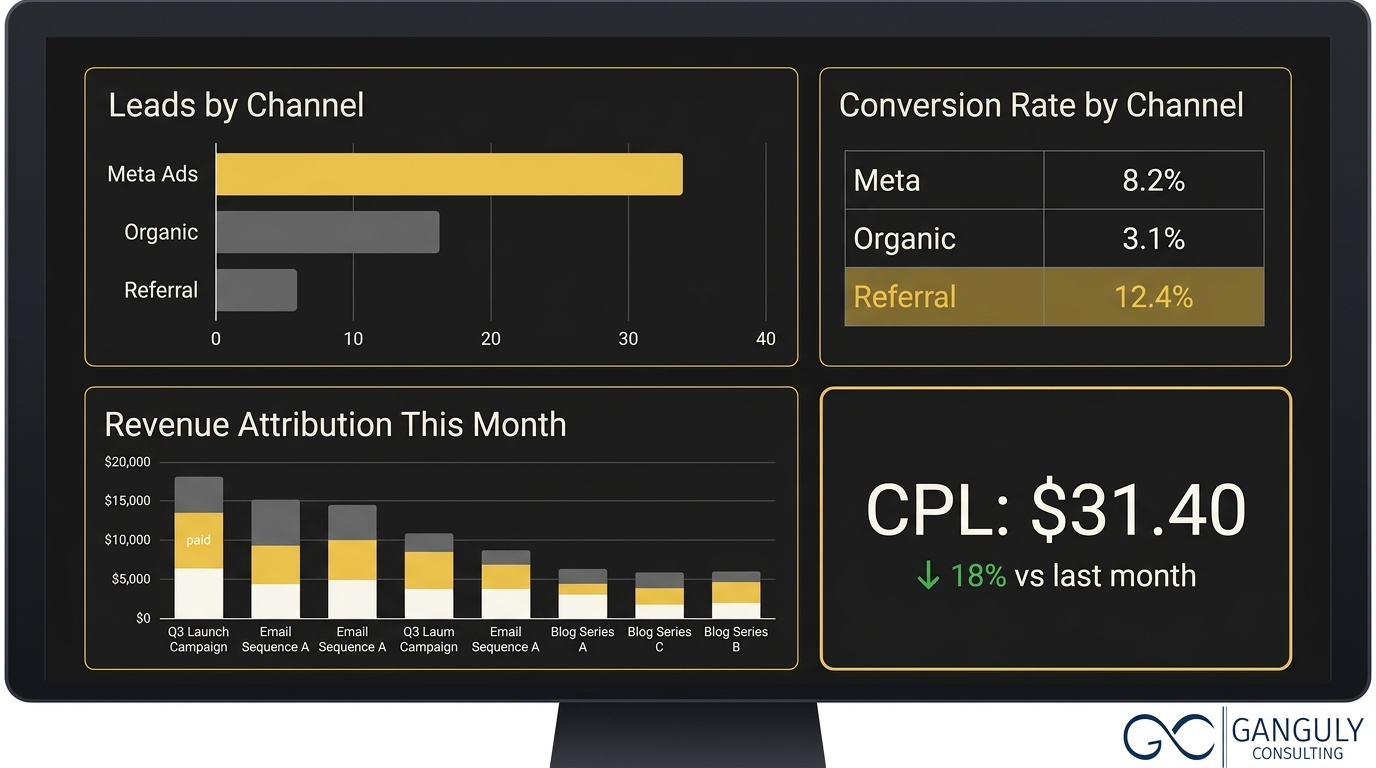
A service business with mature marketing measurement can answer these five questions at any time, without pulling data from multiple platforms:
- How many leads did we generate this month, and what channel did each one come from?
- What's our conversion rate from lead to booked call by channel?
- What's our cost per lead by campaign?
- Which campaigns generated clients (not just leads) this month?
- What's our marketing-attributed revenue this month versus last month?
These aren't difficult questions. They require a specific infrastructure to answer — but that infrastructure is not expensive or technically complex. It requires:
- UTM parameters on every ad and email link (30 minutes to set up, done once per campaign)
- A CRM that stores source data on every contact (15 minutes to configure)
- GA4 with goal tracking configured for form submissions (1 hour to set up)
- A simple Looker Studio report that connects GA4 and CRM data (2–3 hours to build once)
The businesses that can answer all five questions above aren't running enterprise-grade measurement systems. They're running a connected version of the same tools everyone else uses. The difference is that the connections were built deliberately.
Only 29% of marketers consider themselves "best-in-class" at using attribution to achieve strategic objectives (RevSure/Ascend2, 2024). Getting into that 29% for a service business doesn't require a data science team. It requires an afternoon to set up UTMs, an hour to configure CRM source tracking, and a discipline of reviewing three numbers every Monday morning.
The Business Case for Getting This Right
The case for measurement isn't just about accountability. It's about compounding returns.
When you can attribute revenue to specific campaigns, you can make the decision that most service businesses can't: stop spending on the channels that aren't working and double down on the ones that are. That decision, made with confidence, compresses cost per acquisition and expands margin without increasing total spend.
74% of marketing leaders have killed or scaled back campaigns they couldn't measure — not because they were failing, but because they couldn't prove they weren't (Haus, 2026). That means that in the majority of businesses, campaigns that were working were cut because the attribution infrastructure didn't exist to make the case for keeping them. The measurement problem isn't just a reporting problem. It's a budget allocation problem — and over time, it systematically defunds the channels that are actually producing.
For a service business, the compound effect is significant. A business that knows its Meta ads produce clients at a $400 cost per acquisition — and can prove it — should scale that channel. A business that can't make that connection will either cut it when results feel uncertain or continue spending without confidence in what it's producing. Both outcomes are worse than the alternative.
Frequently Asked Questions
Do I need a marketing analyst or data team to set up proper attribution?
No. The infrastructure for basic-to-intermediate attribution — UTM parameters, CRM source tracking, GA4 goals, and a Looker Studio report — can be set up by a non-technical founder with a few hours and free documentation. Where professional help becomes valuable is in configuring multi-touch attribution models, building custom CRM reports that pull cross-platform data, or interpreting attribution data across a complex multi-channel campaign. For most service businesses, the basic setup is within reach without specialist help.
My sales cycle is 60–90 days. How do I attribute revenue to campaigns that started months ago?
This is exactly why your CRM is the right attribution system — not your ad platform. Your CRM should store the source of every lead on their contact record from day one. When a lead that entered three months ago finally closes, the CRM knows which campaign brought them in. Your ad platform's 7-day or 28-day attribution window is irrelevant — the source data is in the CRM regardless of when conversion happens. Review attribution reports monthly rather than weekly for long-cycle service businesses.
What's the difference between last-click attribution and multi-touch attribution?
Last-click attribution assigns 100% of conversion credit to the final marketing touchpoint before a lead converted — typically the ad that drove the last click or the form on the landing page. It's simple and easy to set up, but it systematically undervalues early-stage content (blog posts, LinkedIn content, awareness ads) that built the trust that made the final conversion possible. Multi-touch attribution distributes credit across multiple touchpoints — typically either linearly or with higher weighting to first and last touch. For service businesses with longer consideration cycles, even a simple first-touch + last-touch model is more accurate than pure last-click.
How do I handle referral attribution when a client was referred by someone who found me through my content?
Referral attribution is genuinely hard to capture automatically. The practical approach: when a new lead enters your CRM, your intake form should ask "How did you hear about us?" with a specific list of options including "referred by [name]" as a field. When someone says they were referred, note both the referrer and how the referrer found you — that second layer often traces back to blog content, LinkedIn posts, or other marketing. This won't be captured perfectly, but it's far more informative than ignoring referral attribution entirely.
Which is more important: tracking opens and clicks in email, or tracking form submissions and calls?
Form submissions and calls — always. Email opens are inflated by Apple Mail Privacy Protection (which pre-loads tracking pixels regardless of whether the email was actually read). Click rates are more reliable but still measure activity rather than outcome. The metric that matters is whether someone took a step that moved them toward becoming a client: filled out a form, booked a call, replied to an email. Configure GA4 goals around those actions. Track form submissions and call bookings as your primary email sequence KPIs, not open rates.
Measurement Is What Makes Confidence Possible
The 21% who can prove their marketing ROI aren't smarter or luckier than the 79% who can't. They built the infrastructure that makes measurement possible — UTMs, CRM source tracking, attribution windows calibrated to their sales cycle, and a weekly habit of reviewing three outcome metrics rather than ten activity metrics.
That infrastructure doesn't require a large budget or a technical team. It requires an afternoon to set up, a decision to review the right numbers consistently, and the willingness to let data — rather than intuition — drive where the marketing budget goes.
The businesses that build this infrastructure stop guessing about what's working. They stop cutting campaigns that are performing because they can't prove they are. They stop increasing budget on channels that look active but don't produce revenue. They start compounding — because every month's data makes next month's decisions better.
That's what being in the 21% actually means. Not a report. Not a dashboard. A decision-making advantage that compounds over time.
Read more: The Complete Guide to Building a Digital Growth System for Service Businesses
Abhisek Ganguly is the founder of Ganguly Consulting, a premium tech and growth consulting firm that helps service businesses build integrated digital growth systems. Ganguly Consulting works at the intersection of technology, marketing, and business strategy.