
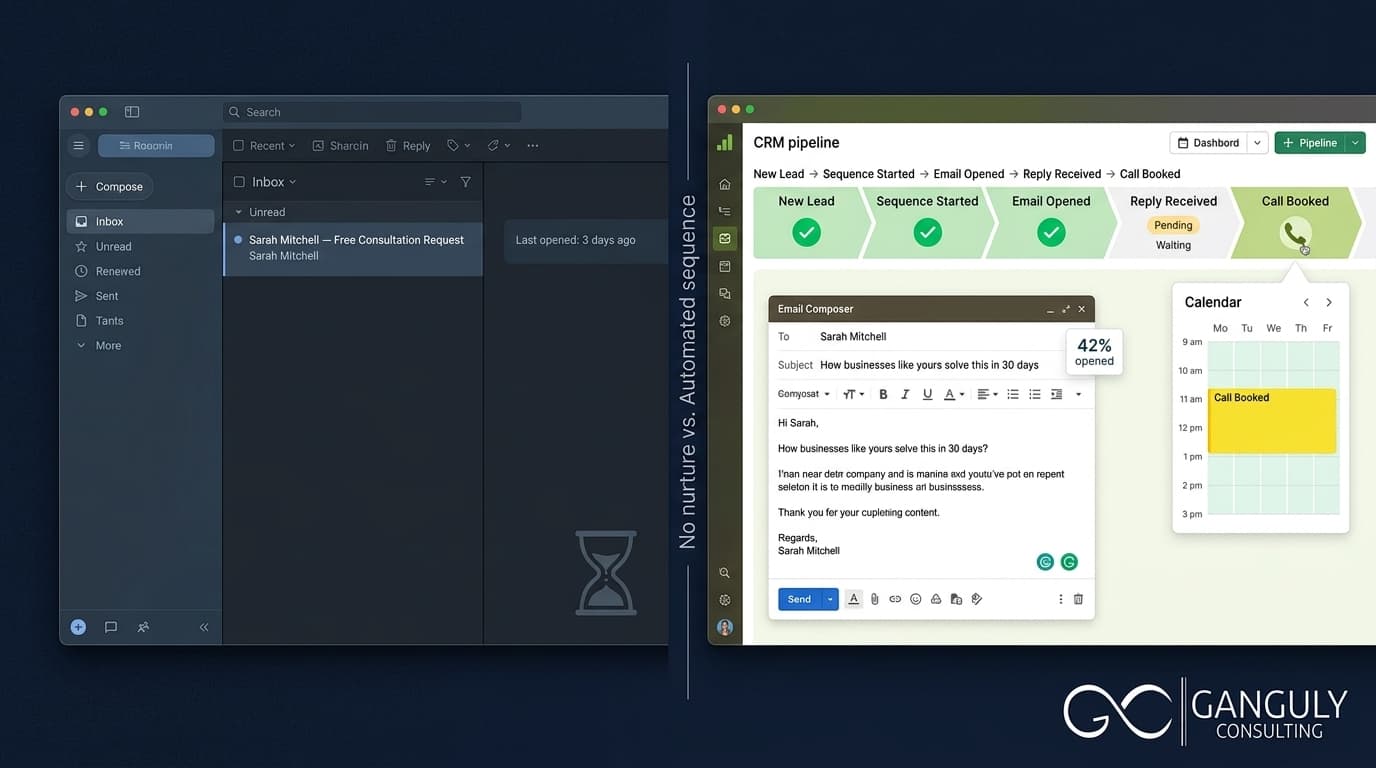
65% of businesses have no lead nurturing process. Here's why leads go cold after the first touchpoint — and a step-by-step system to fix it without a marketing team.
Why 65% of Businesses Have No Lead Nurturing Process (And How to Build One)
You ran the ads. You got the leads. They filled out the form — and then nothing happened.
Not because the leads were bad. Not because your offer was wrong. Because there was no system waiting on the other side to move them forward.
This is the most common and most expensive gap in a service business's digital setup. A lead that doesn't hear from you within the first hour is 7 times less likely to convert than one that does (Harvard Business Review, cited widely in sales research). And yet 65% of businesses have no lead nurturing process at all (Sopro, 2025).
That's not a data point about large enterprises with broken sales departments. That's the majority of service businesses — consultants, agencies, contractors, clinics, law firms — collecting leads and letting them go cold by default.
This post explains why it happens, why it costs more than most owners realize, and how to build a nurturing process that runs automatically — without a marketing team, without expensive software, and without rebuilding your entire operation.
Read more: How to Build a Lead Generation System That Doesn't Depend on Referrals
Key Takeaways
- 65% of businesses have no lead nurturing process in place (Sopro, 2025)
- Nurtured leads make 47% larger purchases than non-nurtured leads (Annuitas Group, cited in Demand Gen Report)
- Companies that excel at lead nurturing generate 50% more sales-ready leads at 33% lower cost (Forrester Research)
- A basic nurture sequence — 3 emails over 5 days — is enough to move most cold leads to a booked call
- The entire system can be built in a weekend with tools you likely already pay for
What Lead Nurturing Actually Means (and Why Most Businesses Skip It)
Lead nurturing is the process of staying in contact with a prospect between their first touchpoint and the moment they're ready to buy. That's it. It's not complicated. But for most service businesses, it doesn't happen.
Here's why.
The typical service business treats lead generation as a funnel with two stages: someone raises their hand (fills a form, sends a DM, clicks an ad), and then either they book a call or they don't. If they don't book immediately, they get filed in a mental "maybe later" category — and then forgotten.
This assumes that every lead is either ready to buy right now or not worth following up with. That assumption is wrong. Research consistently shows that 50% of the leads in any pipeline are not yet ready to buy at the moment of first contact (Marketo, cited in Demand Gen Report). They're interested. They have the problem. They may have the budget. But the timing isn't right yet, or they need more context before they'll commit to a conversation.
Those leads don't disappear. They buy from whoever stayed in contact.
Our observation: When we audit a service business's pipeline, we almost always find the same pattern: a cluster of leads from 3–6 months ago that were never followed up with after the first message. Some of them have since hired a competitor. Some are still searching. The difference is rarely the quality of the offer — it's who showed up consistently after the first touchpoint.
The reason businesses skip nurturing isn't laziness. It's that nurturing feels like a manual process that doesn't scale. Writing individual follow-up emails to every lead that doesn't book immediately sounds exhausting. And it is — if you do it manually. The answer isn't more effort. It's a sequence that runs without you.
Read more: Why Your Website, Ads, and CRM Need to Work as One System
The Real Cost of Letting Leads Go Cold
The cost of no lead nurturing process isn't just the leads that go cold. It's the compounding effect of every cold lead over every month you run ads.
Here's how the math works against you.
Nurtured leads make 47% larger purchases than leads who were never followed up with (Annuitas Group, cited in Demand Gen Report). Companies that excel at lead nurturing generate 50% more sales-ready leads at 33% lower cost (Forrester Research). These aren't outlier results. They represent the difference between a lead flow that compounds and one that resets every month.
For a service business running $3,000 a month on Meta ads, the average cost per lead at $27.66 (WordStream, 2025) means roughly 108 leads per month. If 5% book a call immediately, that's 5 new conversations. The other 103 go cold. Without a nurture process, you pay $3,000 next month to refill the pipeline with another 108 leads — and the cycle repeats.
With a nurture process, those 103 leads don't go cold. Some of them book next week. Some book next month. The leads you paid for last quarter are still converting. Your effective CPL drops. Your pipeline deepens without increasing ad spend.
That's why fixing the nurture gap is usually more valuable than increasing the ad budget.
Our observation: The businesses we see with the highest ROI on their ad spend are almost never the ones with the best creatives or the most sophisticated targeting. They're the ones who built a follow-up sequence that runs for 30–60 days after a lead first enters the pipeline. The ads get credit for leads. The nurture sequence is what actually closes them.
Why the First Hour Matters More Than the First Week
Speed-to-lead is the single most underestimated variable in service business sales. The research has been consistent for over a decade: responding to a lead within 5 minutes increases conversion rates by 9x compared to responding after 30 minutes (LeadSimple, citing Harvard Business Review data).
Most service businesses don't respond in 5 minutes. They respond when someone checks their email. That might be an hour. It might be tomorrow morning.
By then, the lead has moved on. They've searched for three more providers. They've clicked on a competitor's retargeting ad. They've had second thoughts. The window of intent that made them fill out your form is closing with every minute that passes.
This is a solvable problem — and it doesn't require anyone to be glued to their phone.
An automated first-response email, sent within 60 seconds of form submission, does three things:
- It confirms the lead that their inquiry was received (removes doubt)
- It sets an expectation for when they'll hear from you in person
- It delivers immediate value — a resource, an insight, a short video — that keeps them engaged while they wait
That first automated message isn't a sales email. It's a trust signal. It tells the prospect that you're organized, responsive, and professional before they've spoken to a single person on your team.
Read more: Why Your Website, Ads, and CRM Need to Work as One System
The Anatomy of a Lead Nurture Sequence That Works
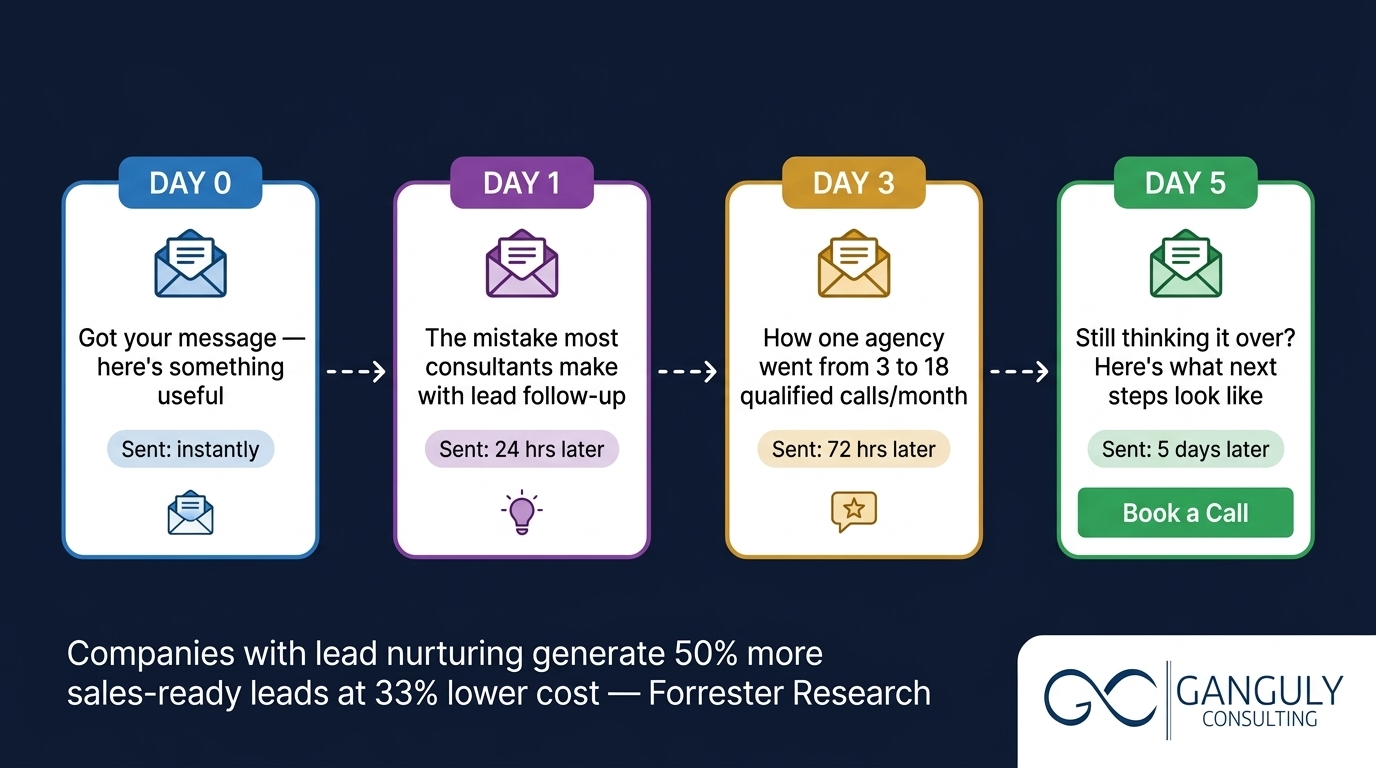
You don't need a 10-step, 30-day drip campaign to start seeing results. A four-email sequence, delivered over five days, is enough to qualify, educate, and convert most of the leads who didn't book on the first touchpoint.
Here's the structure:
Email 1 — Day 0, sent immediately (Confirmation + Value)
Subject: "Got your message — here's something useful while you wait"
Purpose: Confirm receipt, set expectations, deliver immediate value. This is not a sales email. Share one piece of content — a short article, a relevant insight, a 3-minute video — that directly relates to the problem that made them fill out your form. Keep it under 150 words.
Email 2 — Day 1 (The Reframe)
Subject: "The mistake most [service business type] make with [their problem]"
Purpose: Introduce your perspective and frame the problem differently. This is where you demonstrate that you see what they're dealing with more clearly than they expected. It's the first email that begins to build intellectual trust. Still no hard sell. End with a question that invites a reply.
Email 3 — Day 3 (Social Proof)
Subject: "How [client type] went from [problem] to [result] in [timeframe]"
Purpose: A brief, specific case study or client result. One paragraph describing the situation, what changed, and the outcome. Don't name clients without permission — describe the profile. This email does the selling without selling. It shows them the transformation is real.
Email 4 — Day 5 (Soft CTA)
Subject: "Still thinking it over? Here's what the next step looks like"
Purpose: A direct, low-pressure invitation to book a call. Describe what happens on the call (no pitch, just a conversation to see if there's a fit), how long it takes (30 minutes), and what they'll leave with (clarity on their biggest digital growth gap). Include a direct booking link.
This sequence works because it respects the lead's timeline while staying present. You're not pushing for a sale in every message. You're building familiarity, demonstrating expertise, and making it easy for someone to take the next step when they're ready.
Most service businesses that implement this sequence see the majority of conversions come from emails 3 and 4 — not the first touchpoint. That's the entire point of nurturing.
What Tools You Actually Need (and Which Ones to Skip)
The most common objection to building a nurture process is tool complexity. Business owners assume it requires enterprise software, a marketing ops hire, or a complicated automation setup. It doesn't.
Here's the minimum viable stack:
CRM with email automation: HubSpot (free tier covers this), GoHighLevel, ActiveCampaign, or Mailchimp Automations. Any of these can trigger an email sequence when a new contact is added. You do not need Salesforce. You do not need Marketo.
Form connected to your CRM: Your existing contact form (Typeform, Gravity Forms, WPForms, or your website builder's native form) almost certainly has a Zapier or native integration with your CRM. Set it up once. Every form submission goes directly into your CRM and triggers the sequence.
Booking link: Calendly (free tier), Cal.com (free), or HubSpot's built-in meeting scheduler. This goes in email 4. The lead books directly into your calendar without a back-and-forth.
That's it. Three tools, most of which you likely already pay for, connected by one automation. The entire setup takes a few hours — not weeks.
What you don't need: a marketing team, a dedicated content calendar, a social media presence, or any new ad spend. This system works on the leads you're already generating.
Read more: The 5 Layers of a Digital Growth System Every Service Business Needs
How to Know If Your Nurture Process Is Working
A nurture process you set up and never look at is better than nothing. But a nurture process you measure and improve over time compounds. Here are the three numbers that matter:
Open rate: For a well-written subject line to a warm lead, you should expect 35–50% open rates. If you're below 25%, the subject lines need work or the list isn't segmented correctly.
Reply rate: Email 2 (the reframe) should generate some replies if it's asking the right question. Even 2–5% reply rate on this email is meaningful — those are high-intent leads starting a conversation.
Booking rate: Of the leads that enter your sequence, what percentage book a call? A baseline benchmark is 8–15% for service businesses with a relevant offer and a good sequence. If you're below 5%, the sequence needs work — usually the offer framing or the CTA email.
Review these numbers monthly. Make one change at a time — subject line, body copy, or CTA. After 90 days, a well-iterated nurture sequence becomes a genuine competitive advantage: every lead you pay for stays in your pipeline and keeps working for you.
Our observation: The businesses that skip this step almost always cite the same reason — "we don't have enough leads to justify building a system." This is backwards. The reason they don't have enough leads is partly because the ones they're generating aren't being nurtured. Build the system first, even when the volume is low. When volume grows, you'll be ready.
Frequently Asked Questions
How long should a lead nurture sequence be?
For most service businesses, four to six emails over 5–14 days is the right starting point. Beyond that, the sequence can extend for 30–90 days with lower-frequency touchpoints (one email per week or bi-weekly), but the highest-impact window is the first five days. If a lead hasn't responded after 14 days of consistent, valuable outreach, extend the sequence to monthly "stay-in-touch" emails rather than pushing harder.
What if I don't have any content to share in the nurture emails?
You don't need blog posts or videos to run a nurture sequence. Email 2 (the reframe) is an opinion — your perspective on the problem, written in plain text. Email 3 (social proof) is a two-paragraph story about a client result. Neither requires existing content. The only thing required is an honest, specific articulation of the problem you solve and the results you've produced. Most service business founders have both — they've just never written them down.
Should I manually follow up with leads instead of using automation?
Manual follow-up is not scalable and creates inconsistency — some leads get followed up with, others don't, depending on how busy you are. The goal of automation isn't to make the relationship impersonal. It's to ensure that every lead gets a consistent, thoughtful touchpoint sequence without requiring manual action. Once a lead replies or books a call, that's when personal interaction takes over. Automation handles the volume; you handle the conversations.
Can I add leads to a nurture sequence if they came from somewhere other than a form submission?
Yes. Most CRMs allow you to manually add contacts to a sequence, or to trigger sequences based on tags and list additions. Leads from referrals, LinkedIn outreach, event conversations, or cold email responses can all be added to a nurture sequence manually. The key is having one central place (your CRM) where all leads live and having one sequence that runs by default when a new contact is added.
What's the difference between a nurture sequence and a newsletter?
A nurture sequence is triggered by a lead action (form submission, ad click, inquiry) and is designed to move a specific prospect from awareness to booked call. It's personal, specific to their problem, and time-limited. A newsletter is sent to a broad list on a regular schedule and is designed to maintain awareness and trust over time. Both have value — but the nurture sequence is the one that directly drives revenue. Build that first.
The Leads You're Already Paying For Are Waiting
The businesses that consistently outperform their competitors on lead conversion aren't necessarily running better ads or spending more on their website. They've built a process that stays in contact with every lead, adds value at every touchpoint, and makes it easy for a prospect to say yes when the timing is right.
65% of businesses haven't done this. Which means if you build it — even a basic version — you're in the minority that actually captures the value of the leads you're generating.
You don't need to start with a 30-day sequence, an advanced CRM setup, or a content library. You need four emails, a booking link, and an automation that fires when someone fills out your form. Start there.
The leads are already in your pipeline. The system just needs to be built.
Read more: How to Build a Lead Generation System That Doesn't Depend on Referrals
Abhisek Ganguly is the founder of Ganguly Consulting, a premium tech and growth consulting firm that helps service businesses build integrated digital growth systems. Ganguly Consulting works at the intersection of technology, marketing, and business strategy.