
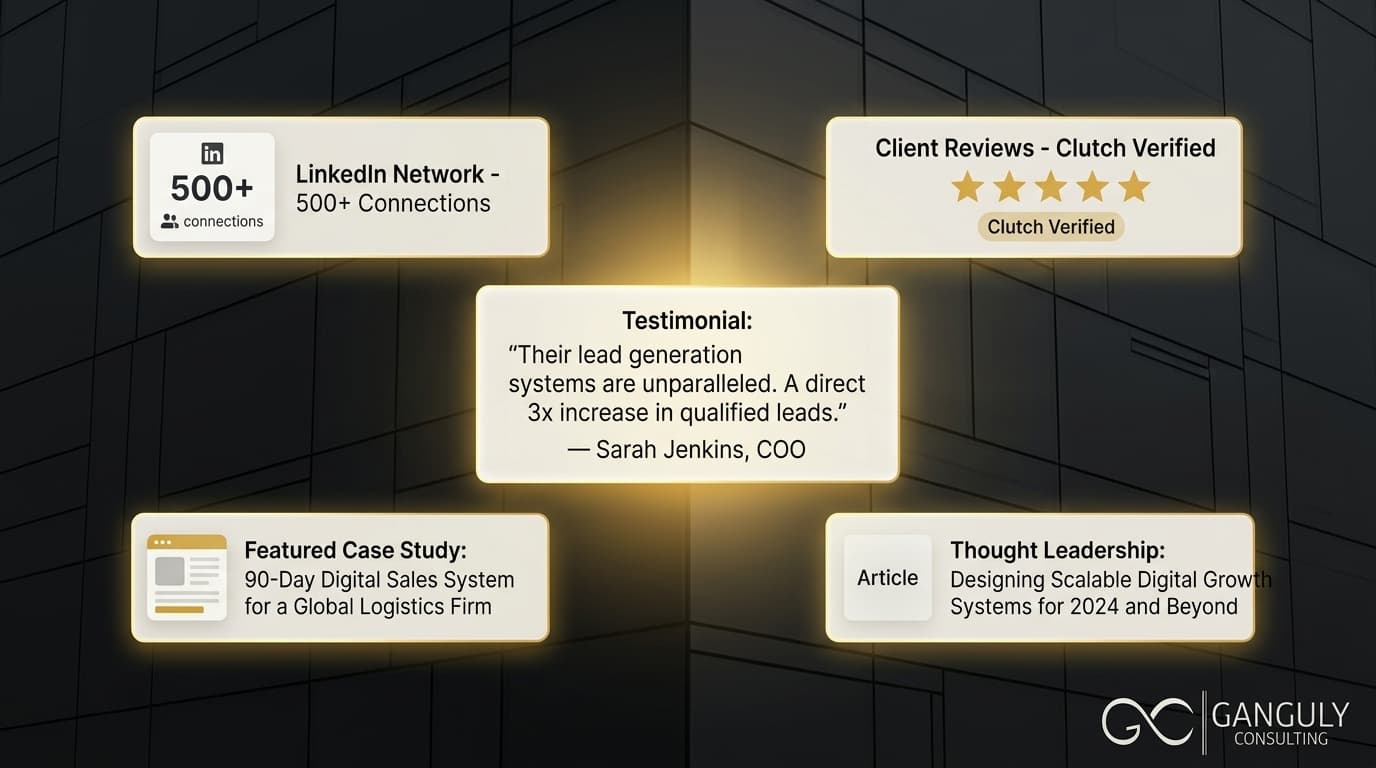
60% of B2B decision-makers will pay a premium to work with thought leaders. But thought leadership alone doesn't build trust — it's one element in a trust architecture. Here are the 7 that premium service businesses need.
The Trust Architecture: 7 Elements That Make Premium Clients Trust You Online
Premium clients don't buy on impulse. They research. They compare. They look for signals that tell them whether a service provider is credible before they ever get on a call. By the time a high-value prospect reaches out to you, they've already formed a view — and that view was shaped by everything they encountered online before making contact.
The mistake most service businesses make is treating trust as something that happens in the sales conversation. In 2026, trust is built before the first word is exchanged — across your website, your LinkedIn profile, your content, your case studies, your testimonials, and the consistency of everything they've encountered.
This is the trust architecture: the set of elements that, working together, make a premium prospect feel confident that you're the right choice before they've spoken to anyone on your team.
60% of global B2B decision-makers and C-suite leaders say they are willing to pay a premium to work with an organisation that produces high-quality thought leadership (Edelman + LinkedIn, 2024 B2B Thought Leadership Impact Report). That premium isn't just for content — it's for credibility. Content is one element of the architecture. This post covers all seven.
Read more: The Complete Guide to Building a Digital Growth System for Service Businesses
Key Takeaways
- 60% of B2B decision-makers will pay a premium to work with organisations that produce high-quality thought leadership (Edelman + LinkedIn, 2024)
- 75% of B2B decision-makers say thought leadership convinces them to research a provider they weren't previously considering (Edelman + LinkedIn, 2024)
- 84% of B2B buyers use online peer review sites when evaluating a purchase (G2 + Heinz Marketing, 2024)
- 94% of B2B marketers agree trust is critical to B2B success; brands using video are 2.2× more likely to be trusted (LinkedIn + Ipsos, 2025)
- Consistent brand presentation across all platforms increases revenue by up to 23% (Lucidpress + Demand Metric)
Why Trust Works Differently for Premium Clients
A $500 service and a $15,000 service require different trust thresholds. This is not a philosophical observation — it's a practical constraint that determines how your online presence needs to be built.
For low-ticket services, trust is largely transactional: the website looks professional, the reviews are decent, the price is right. The decision is low-risk, so the trust requirement is low.
For premium services — engagements in the $5,000–$100,000+ range — the trust requirement is categorically different. The client is evaluating not just whether you can do the work, but whether you understand their specific situation, whether you'll be credible to their team and their own clients, whether they're confident in your judgment, and whether the relationship will produce the transformation they're paying for.
That level of trust is not built in a sales conversation. It's built over multiple exposures — across content, social proof, expert positioning, and the quality of every touchpoint that precedes the first interaction.
The trust architecture is the set of elements that build that confidence systematically. And for service businesses targeting premium clients, every element that's missing or underbuilt is a tax on your close rate.
Our observation: When premium clients describe why they chose a specific consulting firm or service provider, they almost always describe a multi-touchpoint journey: they read an article, then looked at the LinkedIn profile, then read a case study, then were referred by someone who vouched for the firm. Rarely does any single element close the deal alone. The trust architecture works as a system — each element reinforcing the others until the prospect's confidence threshold is reached.
Element 1: Thought Leadership Content That Demonstrates Judgment
Thought leadership is the most scalable element of a trust architecture. A single well-written article can reach thousands of potential clients and change how a category of prospects thinks about a problem — including whether they consider you the right firm to solve it.
75% of B2B decision-makers say thought leadership convinces them to research a provider they were not previously considering (Edelman + LinkedIn, 2024). 71% of hidden B2B buyers — the ones doing research before they engage with any vendor — say thought leadership is more effective than conventional marketing at demonstrating a firm's potential value (Edelman + LinkedIn, 2025).
Thought leadership for a service business is not content marketing in the generic sense. It's not blog posts designed to rank for keywords. It's a specific kind of writing: demonstrating that you see the client's problem more clearly than they do, that you understand the dynamics they're operating in, and that your perspective on how to address it is more sophisticated than the alternatives.
The test for whether a piece of content qualifies as thought leadership: does it contain a non-obvious perspective that a thoughtful client in your target market would find genuinely valuable? If it's a list of generic tips they could find anywhere, it's not thought leadership — it's content marketing. Both have value, but they produce different trust outcomes.
What to produce: One substantive piece per week — either a blog post (1,500+ words with a specific perspective), a LinkedIn article, or a detailed LinkedIn post with a framework or observation drawn from client work. Volume matters less than consistency and specificity.
Read more: Why Your Website Isn't Generating Leads (And It's Probably Not What You Think)
Element 2: Specific, Results-Based Case Studies
Social proof works at two levels: it tells prospects that others have trusted you, and it shows them what the result of that trust looks like. Generic testimonials accomplish the first. Case studies accomplish both.
73% of B2B decision-makers say case studies significantly influence their purchasing process (DemandGen Report, 2023). What makes a case study effective at building trust with premium clients is specificity: the situation was recognisable, the challenge was real, and the result was concrete.
The structure of a trust-building case study for a service business:
- Client profile (without naming if confidential): "A management consulting firm with 12 consultants, generating $2.4M in annual revenue, primarily from referrals"
- The problem they came with: Specific, in their words if possible — the constraint, the frustration, the gap
- The approach: What you did and why — the thinking behind the work, not just the deliverables
- The result: A specific, measurable outcome with a timeframe — "increased qualified discovery calls from 4/month to 17/month over 90 days"
- A short quote from the client, attributed with their role and company type
One case study like this does more trust-building work than 20 generic testimonials. For premium clients who are evaluating investment of $15,000+, reading a recognisable situation with a credible outcome is the closest thing to a reference call without requiring one.
What to produce: Document three client results as case studies. Start with the client who had the most recognisable problem profile and the most concrete result. Write it in 400–600 words. Add it to a Case Studies or Results page on your website, and link to it from your LinkedIn profile.
Element 3: Founder or Principal Visibility
For service businesses, the principal buys, and the principal delivers. Clients are not choosing a firm in the abstract — they're choosing to work with a specific person. The absence of that person online is an absence of accountability.
82% of customers say they trust a company more when its senior leadership is active on social media and publicly engaged in their field (Humantobrand, 2025). 44% of a company's market value is attributed to the CEO's personal brand and reputation, according to research by Weber Shandwick and KRC Research.
For a service business founder, personal visibility online serves a specific trust function: it lets prospects form a view of your credibility, communication style, and expertise before any sales interaction begins. A prospect who has read 10 of your LinkedIn posts before they book a discovery call is a categorically warmer lead than one who found you through a Google search and has never seen you communicate directly.
Personal visibility doesn't require a large following or a personal brand campaign. It requires consistent, specific public communication about the problems you solve, the perspectives you hold, and the results you've produced. Three LinkedIn posts per week — each one containing an observation, a framework, or a client insight — build visible credibility faster than any advertising campaign.
What to do: Set your LinkedIn presence to public. Ensure your profile headline describes what you do for whom, not your job title. Commit to three LinkedIn posts per week that demonstrate expertise — not promotional posts, but the kind of insight a peer would find worth reading. Within 60 days, your inbound connection and enquiry quality will change.
Element 4: Peer Reviews and Validated Social Proof
84% of B2B buyers use online peer review sites when evaluating a purchase (G2 + Heinz Marketing, 2024). 92% are more likely to purchase after reading a trusted review. For enterprise-level buyers, that number rises: 71% of enterprise B2B buyers actively seek peer conversations during their buying process — and vendors underestimate how much this shapes the decision (TrustRadius + Pavilion, 2024).
Validated social proof — reviews on Clutch.co, G2, or Google Business — carries different weight than testimonials on your own website, because the latter can be curated and the former cannot. A prospect who finds consistent, specific, positive reviews across multiple platforms forms a different level of trust than one who reads testimonials on the site you control.
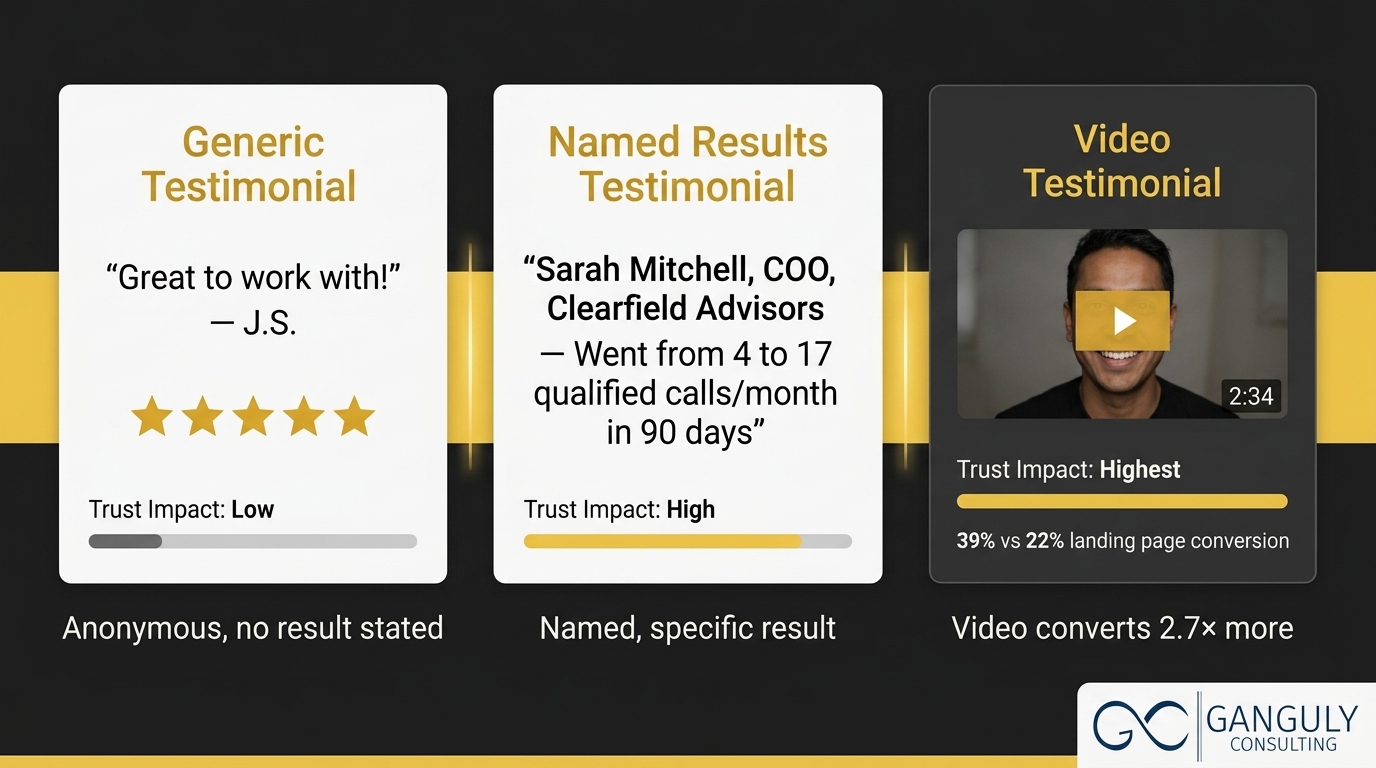
Video testimonials extend this further. Video testimonials generate 2.7× more purchase decisions than written reviews. Landing pages with video testimonials convert at 39% compared to 22% for written-only testimonials (Wyzowl, 2025). For premium service businesses, even two or three 60-second client video testimonials — recorded on a phone, with good lighting and a genuine reflection of the result — produce a disproportionate impact on trust.
What to do: Set up a Clutch.co profile (free) and ask your five most satisfied clients for a review. Clutch's process includes a verification call with the reviewer, which adds credibility. Ask one or two clients for a 60-second video testimonial for your website. Frame the request as a favour and draft the questions for them — most clients will say yes if the ask is specific and easy.
Element 5: LinkedIn Presence as a Credibility Verification Layer
When a high-value prospect encounters your name — through a referral, a Google search, a blog post — the first thing most of them do is search you on LinkedIn. Your LinkedIn profile is the first third-party verification point of your credibility.
LinkedIn generates 277% more B2B leads than Facebook and Twitter combined (LinkedIn internal data, 2025). Its visitor-to-lead conversion rate is 2.74% — nearly three times higher than other social platforms. For professional services, LinkedIn is not a nice-to-have. It's the primary credibility verification tool that sophisticated clients use.
What a premium-client-ready LinkedIn profile contains:
- Headline: Specific outcome-focused claim ("I help professional services firms build integrated digital growth systems — no referral dependency"), not a job title
- About section: 3–5 paragraphs written directly to your ideal client, describing their problem, your approach, and the result — written in first person, without jargon
- Featured section: A link to your best case study or most read article, not your website homepage
- Experience: Each role described with results, not responsibilities ("Built the digital growth infrastructure for 14 service businesses, averaging 2.8× lead volume improvement in 90 days")
- Recommendations: 3–5 genuine recommendations from clients or collaborators who describe a specific result
94% of B2B marketers agree that trust is critical to B2B success, and brands that use video and thought leadership content on LinkedIn are 2.2× more likely to be trusted by their audience (LinkedIn + Ipsos, 2025 B2B Marketing Benchmark).
What to do: Rewrite your LinkedIn headline and About section with your ideal client in mind. Add a Featured section linking to your best case study or article. Ask three clients for written recommendations framed around a specific result. This takes two hours and materially changes what a prospect sees when they look you up.
Element 6: Response Speed and Reliability as a Trust Signal
Trust isn't only built through content and social proof. It's also built through every interaction that follows initial contact. And the first measurable interaction — how quickly you respond to an inquiry — sets the tone for everything that follows.
90% of customers rate an "immediate" response as important when they have a question or inquiry about a professional service (HelpScout, 2024). 82% say they trust a company more when it consistently delivers responsive, reliable service at every touchpoint.
For premium clients, slow or inconsistent response is a trust signal in the wrong direction. It suggests either that the firm is disorganized or that the client isn't yet valued. Neither impression is recoverable easily after it forms.
This is one of the strongest arguments for an automated confirmation email within 60 seconds of form submission — not because automation replaces genuine responsiveness, but because it eliminates the window of doubt between "I submitted this form" and "I know someone received it." The automated confirmation preserves trust while you prepare a genuine, personal response within one business day.
What to do: Set up an automated confirmation email for every form submission on your website. The email should confirm receipt, set an expectation for when they'll hear personally from you, and deliver one piece of immediate value. Review your current average response time and set a target: within 4 hours during business hours for any inbound inquiry, with a personal follow-up within one business day.
Read more: Why 65% of Businesses Have No Lead Nurturing Process (And How to Build One)
Element 7: Brand Consistency Across Every Touchpoint
The final element of the trust architecture is the one that most service businesses underestimate: consistency. Not just visual consistency — though that matters — but the consistency of message, positioning, and tone across every touchpoint a prospect encounters.
Consistent brand presentation across all platforms increases revenue by up to 23% (Lucidpress + Demand Metric, named study). For premium service businesses, where a single client relationship may represent $20,000–$100,000+ in annual value, even a modest improvement in conversion driven by brand consistency produces significant revenue.
Brand inconsistency has a specific trust cost for premium clients. A prospect who reads a sophisticated, specific blog post, then visits a generic homepage, then sees a LinkedIn post with a different positioning claim, experiences cognitive dissonance. The impression isn't "this firm is multifaceted" — it's "this firm doesn't know who they are." For a client considering a high-trust, high-fee engagement, that doubt is disqualifying.
What brand consistency means in practice for a service business:
- The same positioning statement (who you serve, what you do, the result you produce) appears on your website, LinkedIn, your email signature, and any content you publish
- The visual tone — color palette, typography choices, photography style — is the same across your website, LinkedIn banner, and any materials you send
- The voice in your blog posts, LinkedIn updates, and email sequences sounds like the same person
- Every proposal and client-facing document reflects the same premium positioning as your public-facing content
What to do: Write your positioning statement in one sentence. Copy it exactly onto your website hero, your LinkedIn headline, and your email signature. Every other element of your brand communication should orbit that statement. When a prospect encounters you across multiple channels over multiple weeks, they should feel like they're encountering the same coherent, credible entity — not a patchwork of assets from different phases of the business.
The Trust Architecture as a System
These seven elements don't operate independently. Each one reinforces the others, and each one's absence weakens the whole.
A prospect who reads your thought leadership content and finds it compelling will then look at your LinkedIn profile to verify that the author is credible. If the LinkedIn profile is sparse or generic, the trust built by the content is partially undermined. If the profile is strong, it amplifies the content's effect.
A prospect who encounters strong case studies but finds no reviews on third-party platforms will wonder whether the results are representative. A prospect who finds reviews on Clutch but can't find any public content from the founder will wonder whether the firm has genuine expertise or is coasting on past work.
The architecture works because every element contributes something the others can't: content demonstrates judgment, case studies demonstrate results, founder visibility creates accountability, peer reviews provide third-party validation, LinkedIn provides verification, response speed signals reliability, and brand consistency creates the coherent impression that these are all coming from a single, sophisticated entity.
Building all seven takes time. But you can start with the element that's most obviously missing. For most service businesses, that's either case studies (Element 2) or founder visibility (Element 3). Start there. Add the others over the next 90 days.
Frequently Asked Questions
How long does it take to build a trust architecture from scratch?
The foundation — a rewritten LinkedIn profile, one case study, three named testimonials, and an automated response system — takes about a week of focused effort. The ongoing elements — thought leadership content and peer reviews — compound over 90–180 days. You won't see the full effect of the trust architecture in the first month. You'll see it in the quality of prospects who reach out six months from now, how many of them have already read your content before the first call, and how often deals close without extended negotiation.
What if I don't have case study results to share yet?
Start with a documented process case study rather than a results case study. A process case study describes the situation a type of client faces, the approach you take to address it, and the kinds of outcomes that approach typically produces — without naming a specific client or result. It's less powerful than a results case study, but it demonstrates judgment and methodology. Replace it with a results case study as soon as you have one you can document.
Is LinkedIn presence necessary if my clients don't actively use LinkedIn?
LinkedIn is less about your clients using it actively and more about it being the first verification point when they search your name. Even clients who don't post on LinkedIn will Google you and land on your LinkedIn profile. A sparse or outdated profile creates doubt regardless of whether the prospect considers themselves a "LinkedIn person." Treat it as a credential document, not a social platform — update it to reflect your current positioning and let it do its job passively.
How do I get clients to provide video testimonials?
The highest success rate comes from a specific, low-friction ask. After a positive client milestone — a strong result, a successful project close — send this message: "We'd love to share your story with other [client type] facing the same challenge. Would you be willing to record a 60-second phone video describing what you were dealing with before we worked together and what's different now? I'll send you three prompts to make it easy." Most clients who say yes to anything will say yes to this framing.
What does brand consistency look like if I'm a solo consultant?
For a solo consultant or small firm, brand consistency is primarily about language consistency: the same positioning statement across website, LinkedIn, email, and proposals; the same voice in your writing across platforms; the same specific outcomes language in every context. Visual consistency matters but is secondary. Start by writing one paragraph that describes who you serve, what you do, and the result you produce — then make sure that paragraph, in essence, appears on every surface where a prospect might encounter you.
Trust Is Built Before the Conversation Begins
The trust architecture is what makes the difference between a discovery call that starts from zero and one that starts from established credibility. When a prospect has read your thought leadership, seen your case studies, verified your LinkedIn presence, found your Clutch reviews, and received an immediate response to their inquiry — they arrive at that call already confident. The call becomes confirmation of a decision they've largely already made.
For premium service businesses, that pre-call credibility is the highest-leverage investment available. It shortens the sales cycle. It raises the close rate. It attracts clients who are already predisposed to your approach, which makes the engagement itself more productive.
All seven elements of the trust architecture are within reach for any service business, regardless of size. The businesses that build them don't just close more deals — they close better ones, at better prices, with less friction, than those who rely on the sales conversation alone to build the trust that should have been built before anyone picked up the phone.
Read more: The Complete Guide to Building a Digital Growth System for Service Businesses
Abhisek Ganguly is the founder of Ganguly Consulting, a premium tech and growth consulting firm that helps service businesses build integrated digital growth systems. Ganguly Consulting works at the intersection of technology, marketing, and business strategy.